
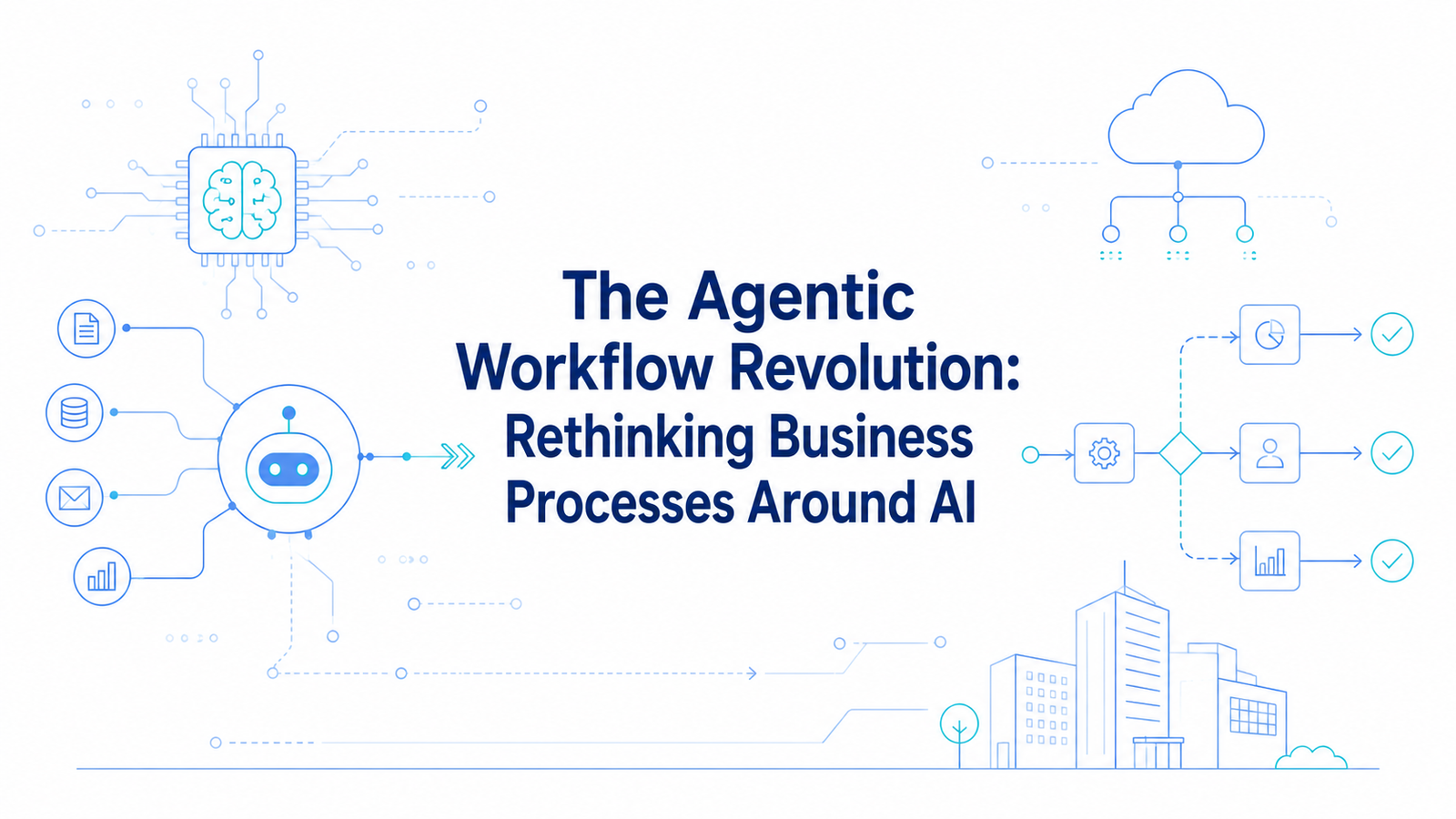
The Agentic Workflow Revolution: Rethinking Business Processes Around AI
Businesses are entering a new era of digital transformation where artificial intelligence is no longer used as a tool to help employees perform routine operations. Agentic AI is now being leveraged as an active agent to make business operations run smoothly and achieve higher performance than before. As businesses strive to become more efficient and agile, agentic workflows have emerged as a powerful tool to enable this transformation.
Agentic workflows enable businesses to achieve transformative improvements in their operations as opposed to simply automating existing processes. The intelligent workflows allow organizations to rethink the way they do things while still being able to retain some of their existing processes. Unlike traditional automation, agentic AI can adapt, learn, and improve business processes continuously and make decisions based on real-time data.
Agentic workflows define a process wherein self-sufficient AI agents perform operations and make decisions to achieve a certain objective. The AI agents can work alongside enterprise systems by interacting with them to gather and analyze information, evaluate options, and take action to accomplish a given task.
Instead of simply automating specific tasks, agentic workflows facilitate end-to-end transformation by connecting various business processes into a well-oiled system. Organizations that are considering hiring Artificial Intelligence development services companies have begun to realize the tremendous potential that agentic workflows offer in transforming the business landscape.
How AI Agentic Workflows Are Changing the Business Landscape
AI agentic workflows allow businesses to transform current processes by introducing elements of continuous intelligence into business operations. In addition to removing the need for constant human intervention, AI agent workflows offer tremendous potential in helping organizations change the way they operate.
For instance, customer service representatives can leverage agentic workflows to interact with customers more efficiently and effectively. AI agents are capable of analyzing past conversations and taking action accordingly. Some of the tasks that customer service representatives can delegate to AI agents include responding to simple inquiries, escalating complex requests, and reminding customers of upcoming appointments. Finance teams can also use AI agents to help them transform their operations while ensuring all transactions meet compliance requirements. Organizations considering adopting intelligent workflows should think about choosing to hire dedicated developer professionals to help them design the best AI workflow system.
Transformative Potential of AI Agentic Workflows
Businesses that are considering adopting AI agentic workflows stand to benefit in various ways.
Higher Operational Efficiency
AI agents can help improve operational efficiency by eliminating repetitive tasks and reducing processing time. Employees can utilize the time saved by delegating monotonous tasks to AI agents to perform more strategic tasks.
Faster Decision Making
Intelligent workflows can help organizations make better business decisions faster. AI agents can analyze vast amounts of data faster than humans and provide pertinent business insights that can be used to make better business decisions.
Improved Customer Experience
AI-driven workflows can lead to improved customer experiences by being able to provide each customer with a unique experience. The AI agents can recommend products and services based on the customer's behavior, preferences, and history. In addition, the smart workflows can improve customer support by helping to route support requests to the most appropriate support channels and provide quick responses to customer inquiries, which results in increased customer satisfaction.
Greater Business Scalability
Agentic workflows can help organizations scale their operations without significantly increasing the employee base. Businesses can leverage the power of AI agents to help them become more productive. Firms that hire AI development services companies can enjoy greater scalability as they are empowered to transform their operations through the use of AI solutions.
Industries That Stand to Benefit From Agentic Workflows
Various industries have started to leverage the advantages that AI agentic workflows offer. Healthcare companies are using AI agents to facilitate day-to-day operations such as sending out appointment reminders, interacting with patients, and assisting doctors with administrative tasks. Financial institutions are using AI-powered chatbots to help detect and prevent fraudulent activities and meet regulatory requirements. Some of the other industries that are using AI agentic workflows to transform their operations include the manufacturing and retail sectors. The manufacturing companies are leveraging AI agents to help them optimize operations, whereas the retail sector is using the smart workflows to help them provide a better customer experience and manage inventory more efficiently. The AI agents are utilized in various applications to help these companies improve efficiency, which is made possible by advanced AI development solutions.
Agentic AI: Challenges to Consider When Adopting Intelligent Workflows
Although many businesses are looking to adopt AI agentic workflows, it is important to consider the following challenges that may arise during the transformation process.
AI agents are only as good as their data and governance processes, and businesses should invest in reliable Artificial Intelligence development services to maximize the benefits of the smart workflows. In addition, companies that intend to adopt agentic AI should implement robust governance policies to ensure that all operations run smoothly and comply with the relevant regulations. Businesses must understand that AI agents are not totally reliable, and it is advisable to remain involved in the key decision-making processes even when the operations are partially automated. Organizations considering adopting the transformative AI workflows should invest in reliable Artificial Intelligence development services and consult experts to develop the best AI governance framework.
Future of Intelligent Workflows and How Businesses Can Prepare
Intelligent workflows will continue to be vital in revolutionizing how businesses operate. The AI agents will be relied upon to achieve more meaningful transformations as opposed to just automating business processes. Organizations need to start preparing for the future by investing in AI development solutions and ensuring they are ready to operate in tandem with the new systems. Some of the first processes that organizations should consider transforming using AI agents are those that have a direct impact on the employees and customers. Businesses can also invest in the best AI development technologies and optimize them for use in their specific applications. As the world continues to embrace digital transformation, businesses need to prepare themselves to become more agile and efficient by adopting smarter ways of working. Many companies are already investing in AI development solutions to ensure they are able to keep up with the ever-evolving business landscape. This allows these organizations to position themselves in a better position to meet the needs of their customers while ensuring they remain ahead of their competitors.
Conclusion
The agentic workflow revolution will continue to transform how businesses operate. Instead of just relying on traditional automation approaches, organizations are beginning to adopt AI agents that can make business decisions and execute them to achieve desirable outcomes. Businesses can benefit tremendously from the transformative potential of agentic AI and use it to improve overall performance while also being able to meet the evolving needs of their customers. Companies that invest in modern AI development solutions can position themselves to maximize these benefits and become future-ready.








0 Comments